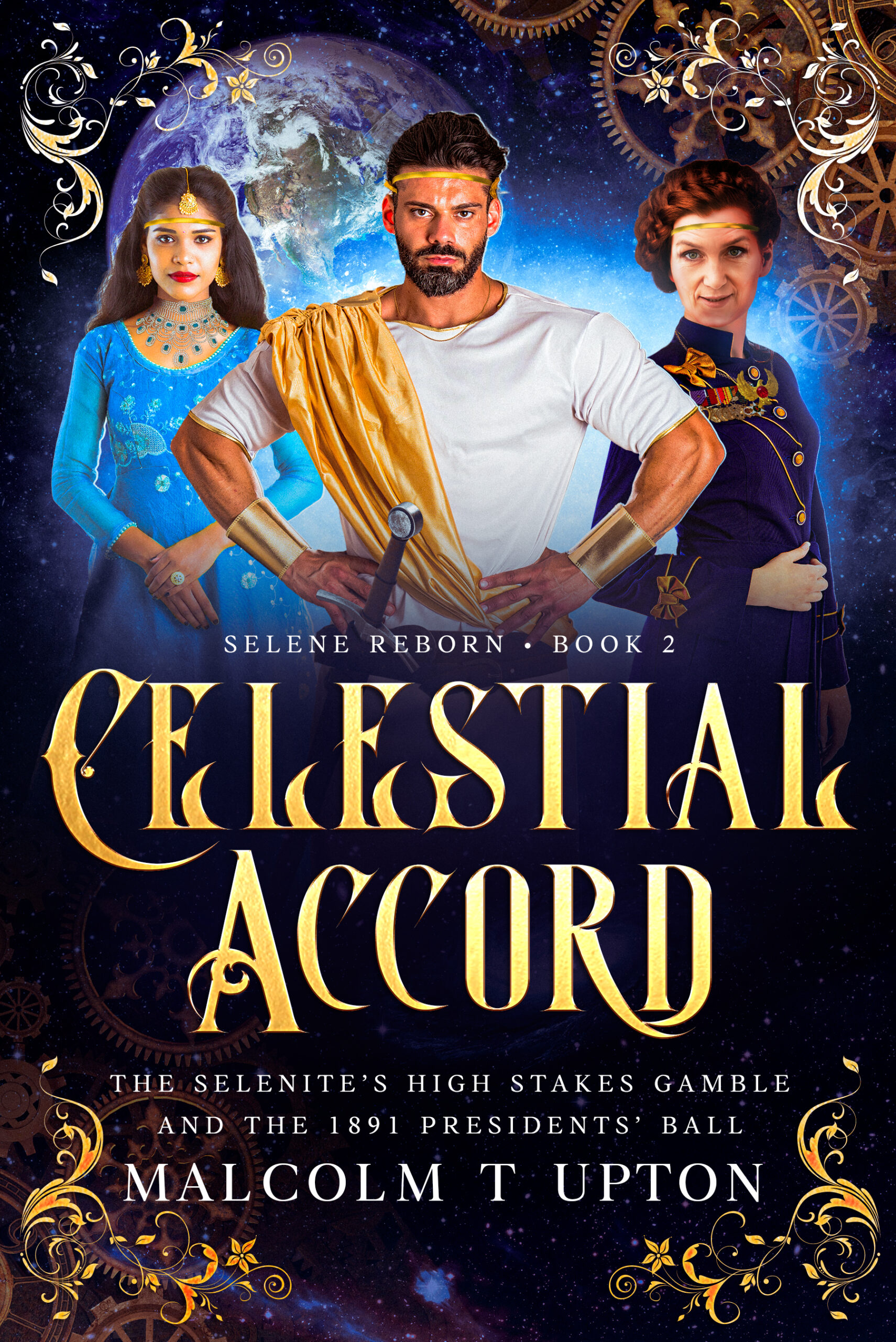
Artemis Rising is #1,820 in Steampunk Fiction, #1,928 in Steampunk Fiction (Kindle Store), and #4,772 in Alternative History. If you don’t have yours yet, you can get the paper version here or the kindle version here. Four customer reviews now, but I need a few more to get Audible to take notice – if you’ve finished the book and haven’t left a review, please do so here.
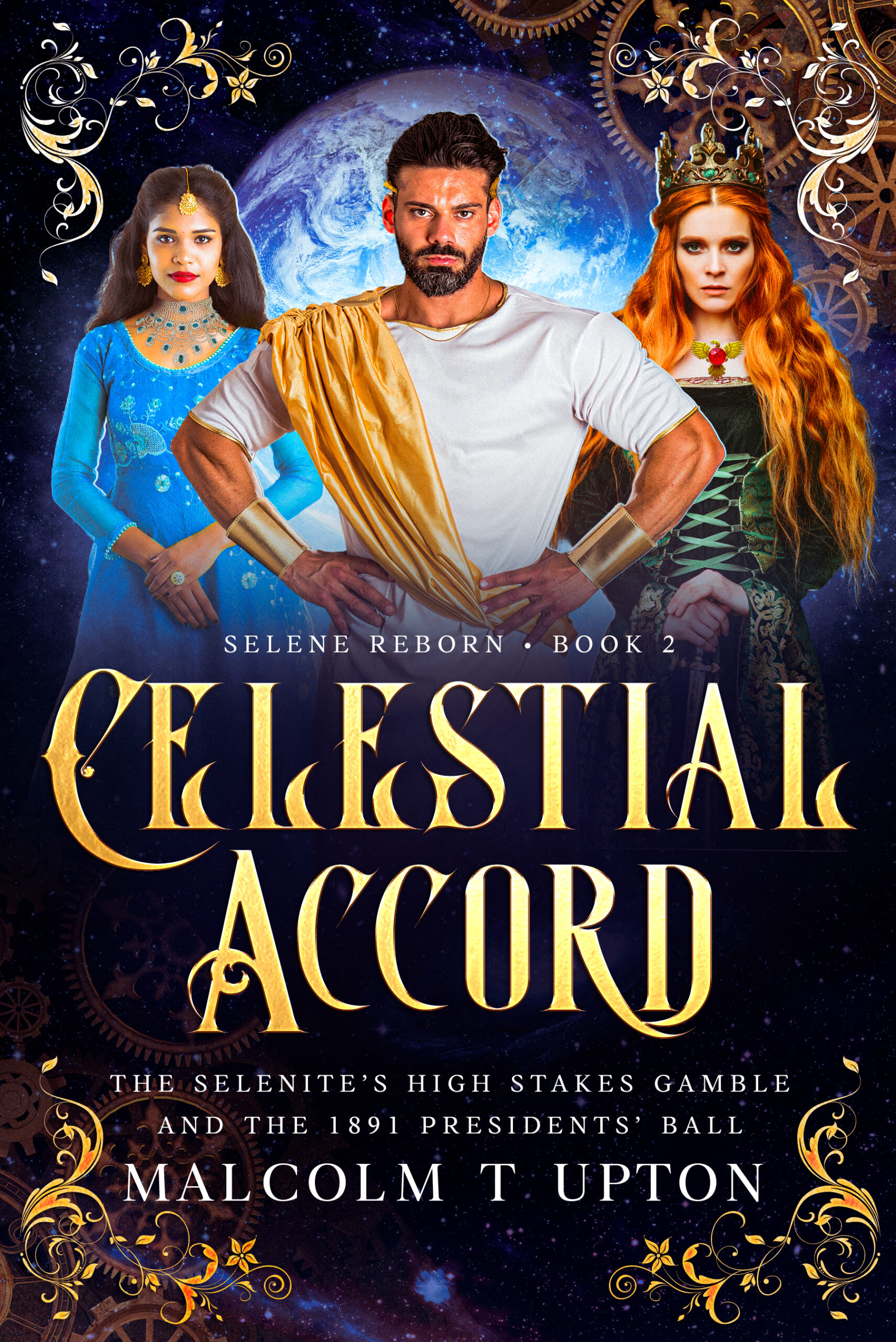
Celestial Accord isn’t ranked yet. If you don’t have yours yet, you can get the paper version here or the kindle version here. No reviews yet either – if you’ve finished the book and haven’t left a review, please do so here.
You can get autographed copies of both books at the Keller Indianettes Craft Show Saturday or Sunday.
I’ll be having an author meet and greet in March at The Reading Rabbit in Azle. Hopefully I’ll have Forging the Chain Breakers available by then.
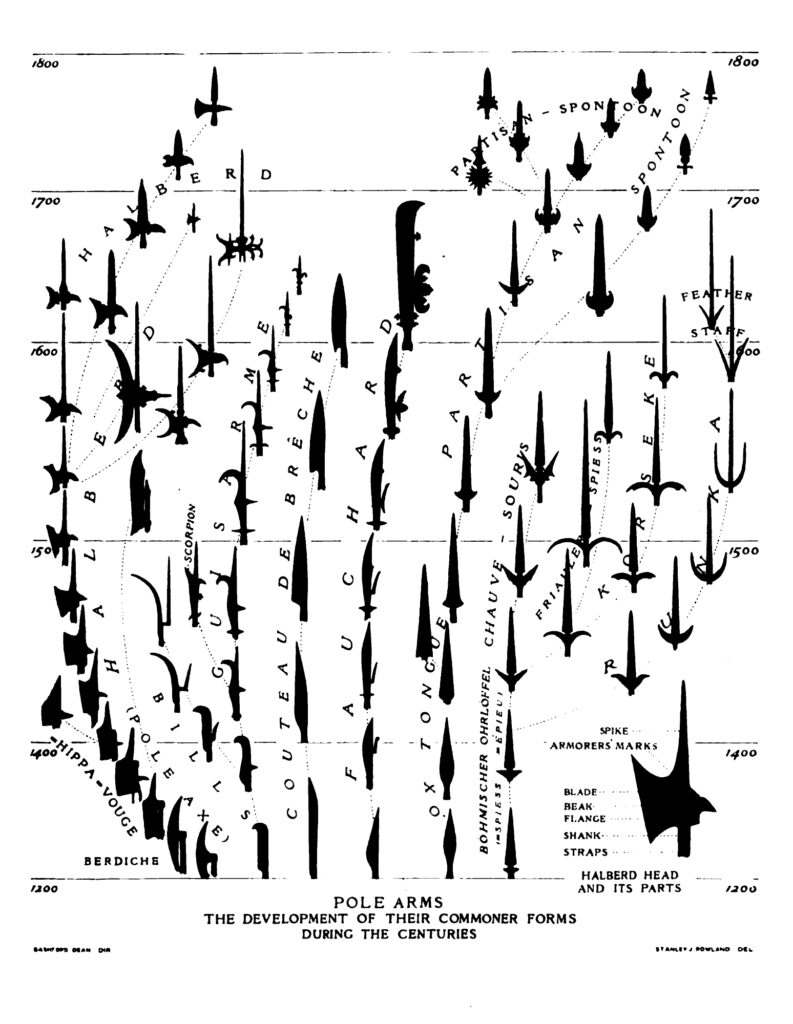
Found out a polearm with a hook to pull knights off horses and a spike to finish them off is called a guisarme. Yes, most polearms at least started as peasant tools put on a longer pole to serve as an improvised weapon. The low place in a crenelated castle wall are the embrasiers. Also found out that the effective range of a modern hunting crossbow is about 40-50 yards. Not very useful against a BAR…
Selene Unchained chapters this week: 11: The Chain Breaking Begins – reworked 12: Refugee Policy 13: Dark Rituals 14: Falling Water 15: Baron Qutab Strikes Back 16: Laughing Pastures – started
Selene Unchained word count is 30,440, not counting Dramatis Personae (1,123 words).
If you want to get early access to Book 3 chapters, write a nice review for Artemis Rising or Celestial Accord on Amazon or Goodreads, and email me that you’ve done it.
Artemis Rising is #1,996 in Steampunk Fiction, #2,132 in Steampunk Fiction (Kindle Store), and #5,469 in Alternative History. If you don’t have yours yet, you can get the paper version here or the kindle version here. Four customer reviews now, but I need a few more to get Audible to take notice – if you’ve finished the book and haven’t left a review, please do so here.
Celestial Accord isn’t ranked yet. If you don’t have yours yet, you can get the paper version here or the kindle version here. Four customer reviews now, but I need a few more to get Audible to take notice – if you’ve finished the book and haven’t left a review, please do so here.
You can get autographed copies of both books at the Lightning Dancers Craft Show Saturday or Sunday.
There is a new description of the first series Selene Reborn. Please check it out here and let me know what you think.
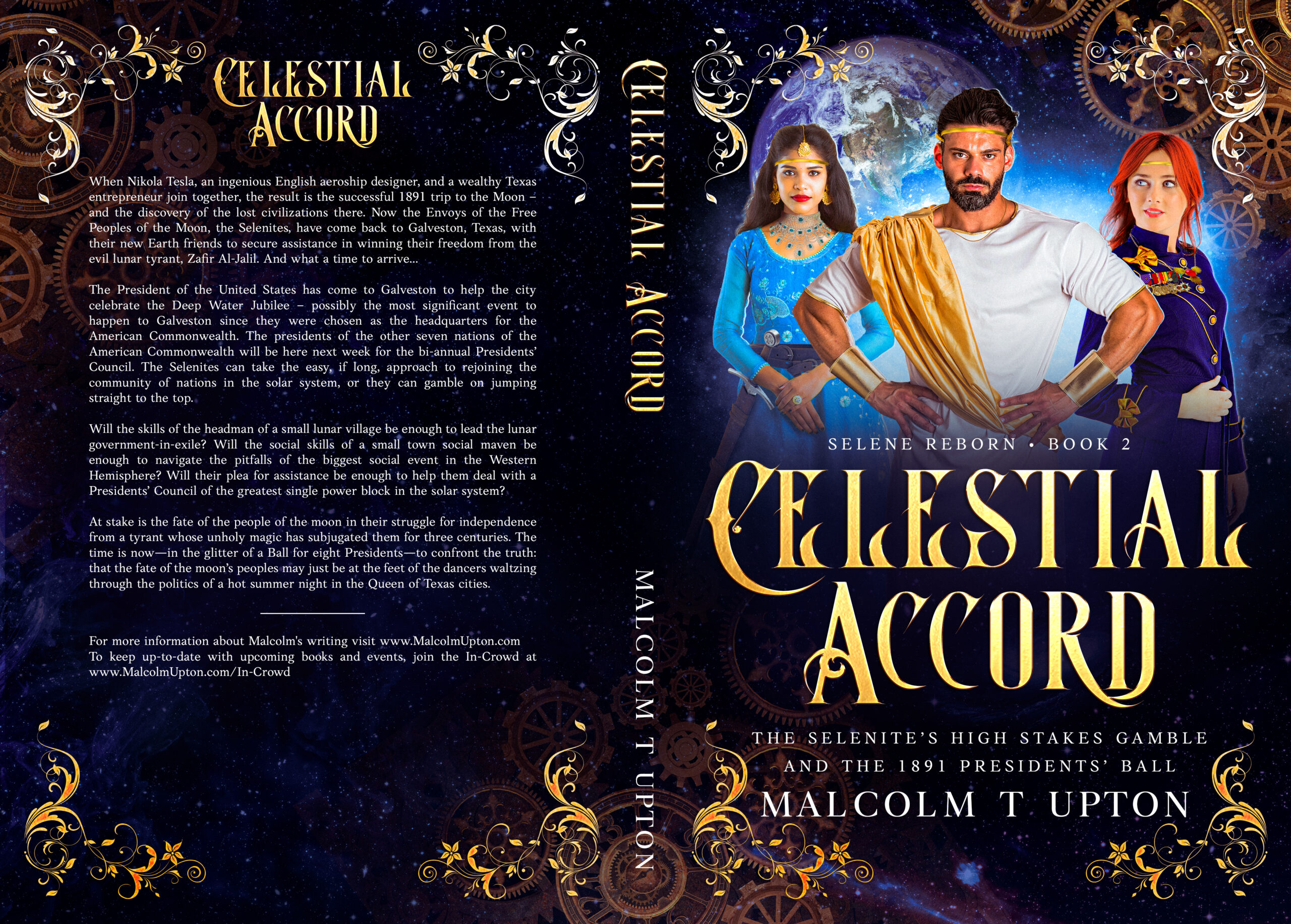
The modifications and additions to Celestial Accord lengthened the book and it needed a very slightly wider spine on the cover. GetCovers.com took care of it for me and the physical book with new front matter and line editing will be available by the end of the week.
Now that Celestial Accord is put to bed, I’ve been able to spend most of my writing time on Selene Unchained. Some of the chapters I’d already written needed modifications, and some were replaced or massively modified.
Ima’s son, the Platoon Sargent, talks to his Platoon Commander about Kobolds. I did some research about Kobolds in German folklore and it was really interesting. https://en.wikipedia.org/wiki/Kobold
Selene Unchained chapters this week: 1: An Air Car Ride – minor modifications 6: A Sorceress, A Marine, and a Spy – minor modifications 7: Elisha and Mirim Return – minor modifications 8: Selene Revealed 9: More Messengers, Better Message 10: The Lunar Atrium 11: The Chain Breaking Begins
Selene Unchained word count is 19,229, not counting Dramatis Personae (975 words).
If you want to get early access to Book 3 chapters, write a nice review for Artemis Rising or Celestial Accord on Amazon or Goodreads, and email me that you’ve done it.
Artemis Rising is #2,057 in Steampunk Fiction, #2,138 in Steampunk Fiction (Kindle Store), and #5,430 in Alternative History. If you don’t have yours yet, you can get the paper version here or the kindle version here. Four customer reviews now, but I need a few more to get Audible to take notice – if you’ve finished the book and haven’t left a review, please do so here.
Celestial Accord has a finalized cover. It took a lot more time and effort this time than the previous three times I’ve used GetCovers.com. I must have had someone new or something. For the first time I had someone use one of the image slots for images that I hadn’t approved and they charged me for additional ones. The cover artist also seemed to have trouble following directions. Oh well, the final product looks fine.
Michael, my line editor, finished his edits and returned the manuscript to me to approve/disapprove edits. I’m going to review them and we’ll have a conversation about word/style choices before he finishes the cleanup. That is where all my effort is going to be focused until it’s finished. That should put Celestial Accord on track for release at the end of October. Even if we are a little late for that, with the cover, I’m releasing the current version on October 31. Available for ebook pre-order now at: https://www.amazon.com/dp/B0FP72PX1G
I’m working with some other artists on two additions to the front matter. One is a Gresham family tree, since the various in-laws, brothers, cousins, etc. have such a significant impact on the story. The other is a map of the American Commonwealth. I’m working with Tomas again on that. I’m hoping he can base it on the Berghaus Star projection of the world map.
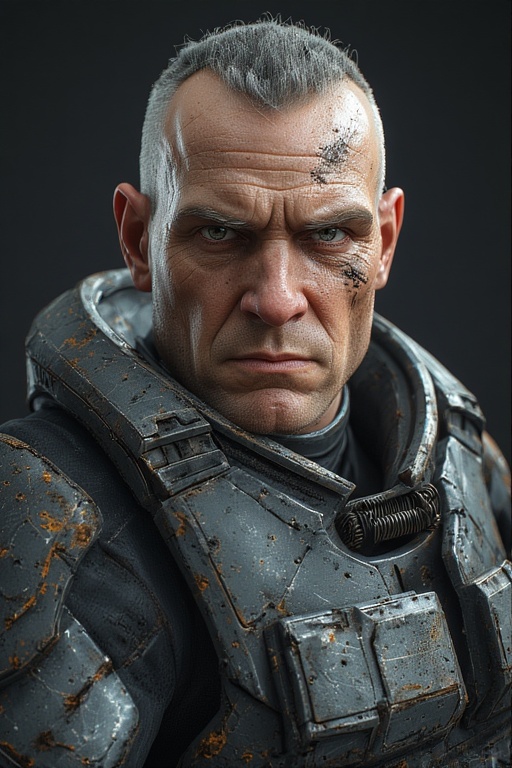
A new, probably minor, character for Selene Unchained: Name: Commander Hrodger, Commander of the 1st Company of the Defender Marines. Age: 97 earth years (appears Late 40s) Race/Species: Human (Defender Base Selenite) Physical Appearance: Broad-shouldered and stern-faced, Hrodger has close-cropped iron-gray hair and a jagged scar bisecting his left eyebrow. He wears his Jager battle suit with the comfort of decades of experience in one. https://greshamverse.fandom.com/wiki/Commander_Hrodger
Selene Unchained chapters this week: 9: Kepler Cluster
Selene Unchained word count is 15,669, not counting Dramatis Personae (890 words).
If you want to get early access to Book 2 chapters, write a nice review for Artemis Rising on Amazon or Goodreads, and email me that you’ve done it.
Artemis Rising is #2,059 in Steampunk Fiction (Kindle Store), #1,550 in Steampunk Fiction, and #5,120 in Alternative History. Still at 3 customer reviews. I need a few more to get Audible to take notice – if you’ve finished the book and haven’t left a review, please do so here.
A Copy Editor has been chosen for Celestial Accord and the manuscript will be headed that direction in a couple of weeks. Chances are we’ll be finished by October and it can be published by Halloween. OK, so that is 4th Quarter, not 3rd Quarter or mid-2025, but it will be better for the wait, I promise.
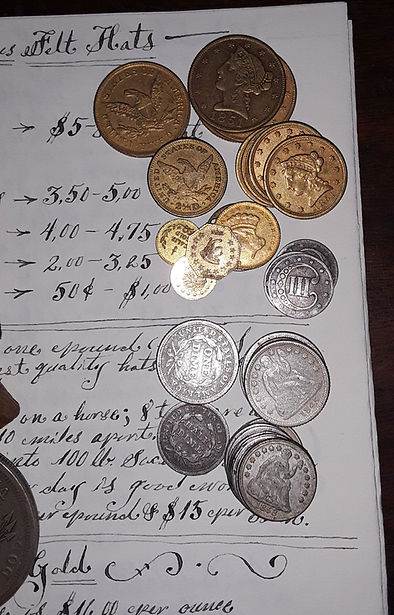
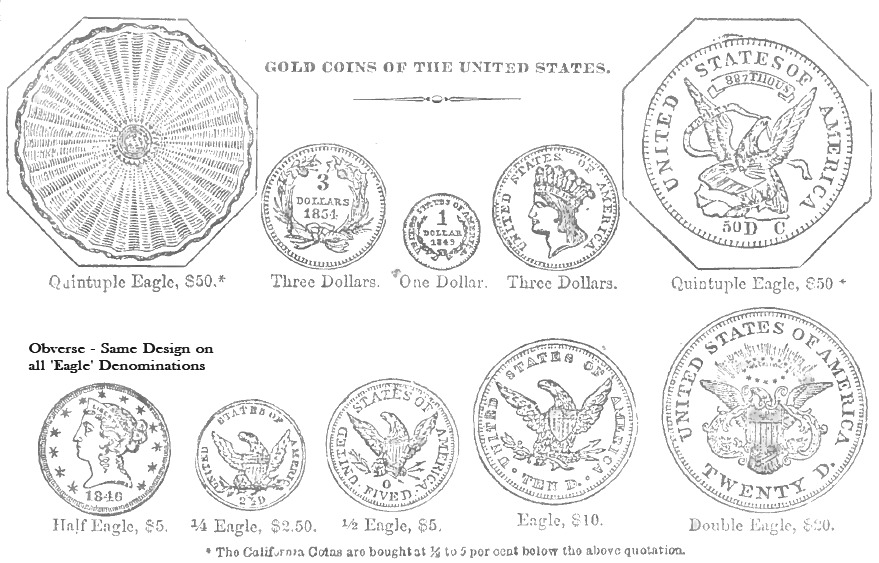
The Shadowy Man needed some bribe money. Being a child of the late 20th Century living in the early 21st, I immediately thought of a Franklin, a $100 bill. Thing is, $100 in 1891 was the equivalent of about $3500 today. There were $100 bills, but they were used like bearer bonds are used today – they exist, but you won’t see them in the cash drawer of a retail business. Next thought was a Jackson, a $20 bill. They existed, in fact they would occasionally show up in retail commerce. This was because there was a law that the US government had to buy a certain amount of silver every month and the government printed special bills to make the purchases. They weren’t really common, however. What were common were the various gold coins. A double eagle was a $20 gold coin and these were what tended to show up in circulation.
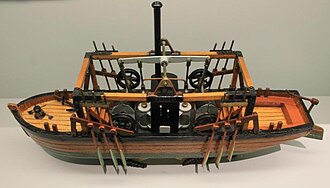
In the 1780’s John Fitch engaged the services of Henry Voigt to help him invent and build a steam engine to power a water craft. The reason he had to develop his own steam engine is because Britain had a technology embargo against its former colony and wouldn’t let the Watt steam engine be exported to the US. That first steamship in the US was the Perseverance.
In 1891, Patrick “Pat” Tiernan was Sheriff of Galveston County. Richard H. Tiernan was the only deputy sheriff listed in the 1890-1891 directory. I guess there’s nothing like keeping it in the family…
Learned some things about Old German names. Adal means “noble”. Beraht means “bright”. Gunda means “battle”. Hart means “hard, firm, brave, hardy”. Gar means “spear”. Learned Nikkal was a goddess married to the Moon in the ancient Levant. There was an ancient Arab moon goddess known as Al-lat (literally the goddess). The Arab female name, Hala, means “moon’s halo” representing ethereal beauty. The Arab female name, Mayar, means “glow of the moon” representing radiance and warmth.
Charon, the largest moon of Pluto, has features such as the Spock, Kirk, Uhura, Skywalker, Organa, and Vader craters. I guess they ran out of gods and old dead guys…
Finished Forging the Chain Breakers this week: 37: The Marine Council (most of Military Pow-Wow moved to chapter 40) 38: Once More Into The Cave 39: Gaisarix Roll-Out 40: Military Pow-Wow 41: Plans for Selene Unchained 42: The Baron Raises The Stakes
Forging The Chain Breakers final word count is 72,567, not counting Dramatis Personae (2,629 words). Developmental Editing scheduled for February.
Selene Unchained chapters this week: Prologue: Zafir Needs a Replacement 1: Planning to Break the Chains – started
Selene Unchained word count is 1,600, not counting Dramatis Personae (295 words). Developmental Editing is tentatively scheduled for March because Sandra is such a professional.
If you want to be a beta reader and comment on Book 2 chapters, write a nice review for Artemis Rising on Amazon or Goodreads, and email me that you’ve done it.
Artemis Rising is #1,964 in Steampunk Fiction (Kindle Store), #1,356 in Steampunk Fiction, and #4,795 in Alternative History. Still at 3 customer reviews. I need a few more to get Audible to take notice – if you’ve finished the book and haven’t left a review, please do so.
Discovered that John Browning invented the guns and Matthew Browning sold them. Kind of like how Eleanor and Walter divide the work. I went back and rewrote the parts with the Browning brothers.
My editor, Sandra, returned the rewrite of Book 2, so I tied up Forging the Chain Breakers and started working on integrating the edits instead. I have them all integrated now. Title is now “Celestial Accord”. I have an order for a new cover from GetCovers.com. I have a request for copy editing on Reedsy. Release by the end of September if I’m really, really, lucky. Chances are it will be at least October instead <sigh>.
Forging the Chain Breakers chapters this week: 36: Browning Assault Rifles 37: A Military Pow-Wow – started
Forging The Chain Breakers word count is 65,912, not counting Dramatis Personae (2,506 words)
If you want to be a beta reader and comment on Book 2 chapters, write a nice review for Artemis Rising on Amazon or Goodreads, and email me that you’ve done it.
This is just too big a learning to be part of the standard weekly blog – so it will get one all its own.
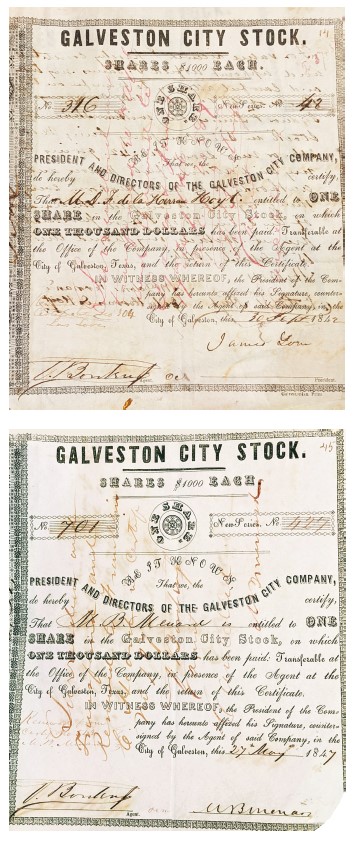
During the time of the Selene Reborn books, the Galveston City Company still had a huge amount of influence on the development of Galveston because they owned virtually all of the undeveloped land in the city.
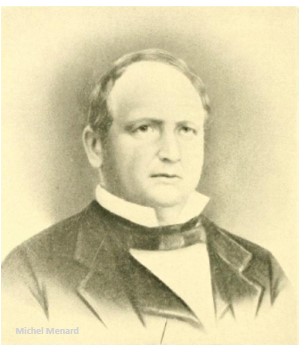
It all starts with Michel Menard, one of the signers of the Texas Declaration of Independence and, among other things, a location surveyor. The surveys most people are familiar with are boundary surveys – what are the boundaries of a tract of land. A location surveyor would go to a tract of land and identify improvements and geographical features that could add value to the land. He performed this service for Juan Seguin on a tract of about 4,605 acres on the east end of Galveston Island. The exact details are unknown, but Seguin gave title to the land to Menard in 1834.
In 1836 Menard petitioned the government of Texas to have the Mexican land grant confirmed. Since the early Texas Congress was notorious for being… chaotic, it isn’t surprising that it wasn’t until 1838, after the Texas Congress had time (and some coups) to get itself organized before they officially deeded Galveston Island to the Galveston City Company consisting of Menard and 9 other early luminaries of Texas and Galveston.
For the next 71 years, the Galveston City Company would sell and/or donate land to guide the growth and expansion of the city of Galveston. In 1891 when Gresham Aerospace is trying to get large tracts of land for their half-mile long aethership factory and such, In addition to getting permission from the City Council to build over where streets are supposed to go, they would need to buy all, or most, of the land from Galveston City Company, Archibald Campbell, agent and secretary.
This is not the way I’ve ever heard of anything going. I guess it is kind of like master-planned communities now days, but without a detailed master plan to start with and with decades of incremental development instead. I think it is interesting that a Communist could make a case that the Galveston City Company is an example of central planning done right since they controlled, or at least influenced, the development of Galveston into a well-organized, prosperous, philanthropic community. Of course a Capitalist would point out that it was a private, for-profit enterprise, not a government agency, that did it…
Artemis Rising is #336 in Steampunk Fiction (Kindle Store), #1,639 in Steampunk Fiction, and #1,258 in Alternative History. Still at 3 customer reviews. I need a few more to get Audible to take notice – if you’ve finished the book and haven’t left a review, please do so.
Thomas Lucas, who lives across Broadway from Gresham Castle, may be an alternate builder for at least the upgrades to First Hangar. Information about Thomas Lucas IRL.
If you haven’t sent a reply with feedback about the title for book 2, please review the list of title suggestions and hit reply.
Not as many chapters this week. Two reasons, Deborah and I spent several days celebrating our 39th wedding anniversary. It takes longer for us old people to celebrate things – that’s my story and I’m sticking to it… Also, what the Shadowy Man is getting up to will be talked about more in this book than originally planned. That means adding some pieces in some of the already completed chapters.
According to the 1890-1891 Galveston City Directory, page 179, David Fahey was proprietor of Uhrig’s Cave saloon, 2102 Market on the corner of 21st Street. Residence same. That is more than enough to inspire even a half-way decent writer to create a setting for the Shadowy Man to pump the bricklayers for information.
John Locke (h) – Bricklayer in Galveston. Roomed with Fannie Stone. I added that he was from Eastside London because I wanted the Cockney accent. His friends were John Lipscomb (h) and George Blake (h) both historical bricklayers that I decided were Galveston natives.
Historically in 1891 there were three foundries in Galveston. One, Lee Ironworks, part of the C. B. Lee & Co. complex, was right near the railroad depot and was the run by the Alderman for the 6th Ward (Northwest Galveston), Charles Lee. Guess where Walter and Company got the steel plates to cover Nike and Artemis…
I’ve had a couple of questions about plans for future books. Those plans have changed a lot since I sat down to write Artemis Rising almost a year ago now. Currently, as of the changes made this morning, the plan looks like this:
The Rise of the Selenites (Series): Artemis Rising [Book 2 – please send your title suggestions] Forging the Chain Breakers Selene Unchained
The Adventures of Walter and Eleanor: Antarctic Honeymoon – may be book 4 of 5 in Rise of the Selenites Secrets of Kilimanjaro
Others: Flight of the Phoenix Beware the Wrath of Magi
Ideas that may become books: Return to Mars – A Walter and Eleanor adventure Getting a Clue – A Walter and Eleanor adventure Old Ones In England – A Walter and Eleanor adventure Fish People of the Amazon – possibly a Walter and Eleanor adventure Secrets of the Sphinx Floating Cities of Venus Dark Side of Mercury Secrets of Ceres Bombing Iapetus War of the Worlds – may be a series War in Heaven – may be a series Emory Upton in Mexico The Rise of Amir Al-Jalil Mike Powell on Mars
Plenty of untold stories and all that assumes I don’t get enough feedback from readers about wanting more story somewhere not covered by this list…
Chapters this week: Shadowy Man additions 2 Chapters split (additional 2 chapters) 27: Preparations for the Council 28: Galveston Aeroport Company – started
Forging The Chain Breakers word count is 48,947, not counting Dramatis Personae (2,183 words)
If you want to be a beta reader and comment on Book 2 chapters, write a nice review for Artemis Rising on Amazon or Goodreads, and email me that you’ve done it.
Artemis Rising is #1,435 in Steampunk Fiction (Kindle Store), #1,579 in Steampunk Fiction, and #3,813 in Alternative History. I got a 3rd customer review, still need a few more to get Audible to take notice – if you’ve finished the book and haven’t left a review, please do so.
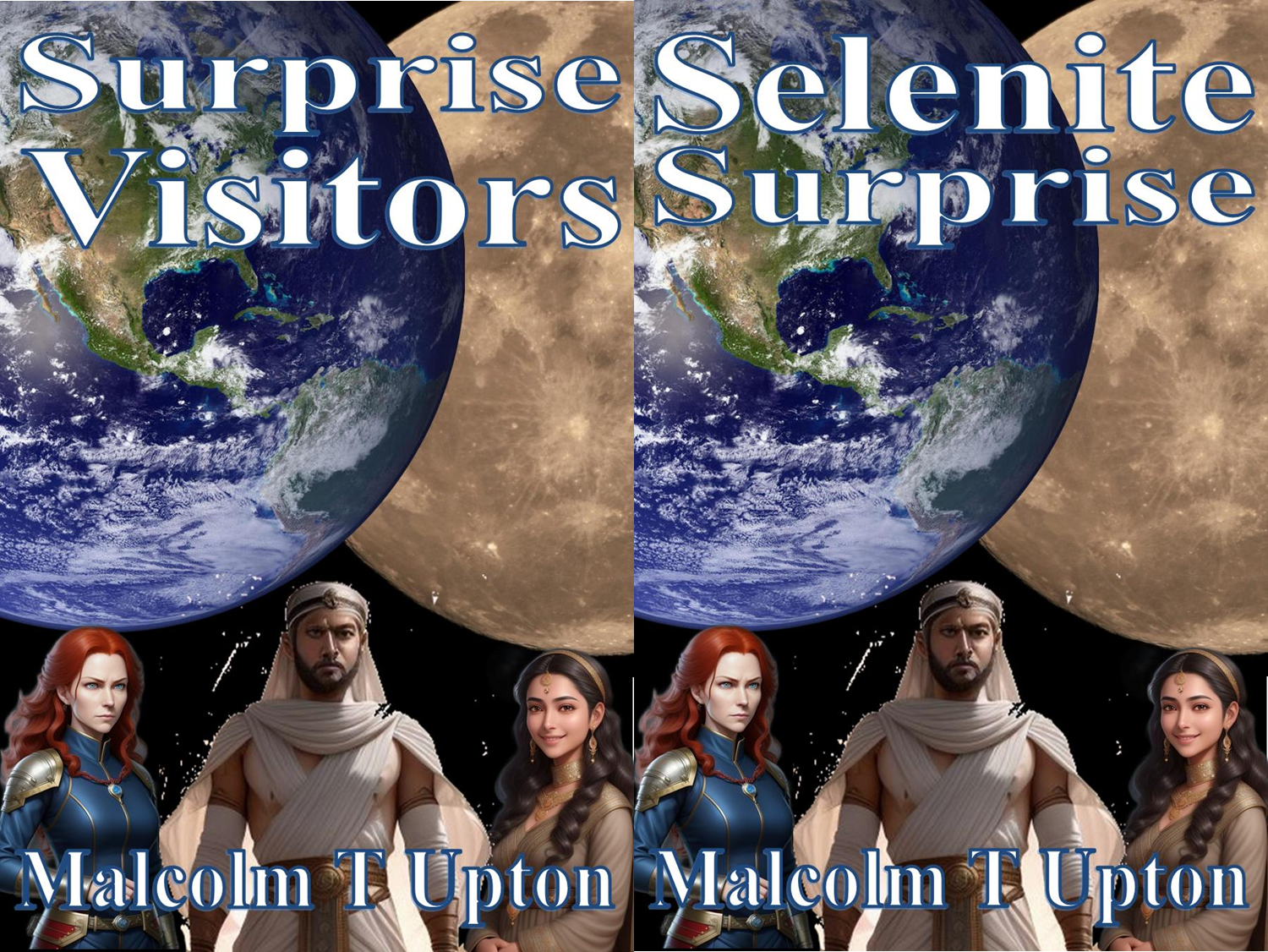
I had another couple ideas for a name for Book 2. “Selenite Surprise” or “Surprise Visitors” Let me know what you think.
NASA 1118 78.3F
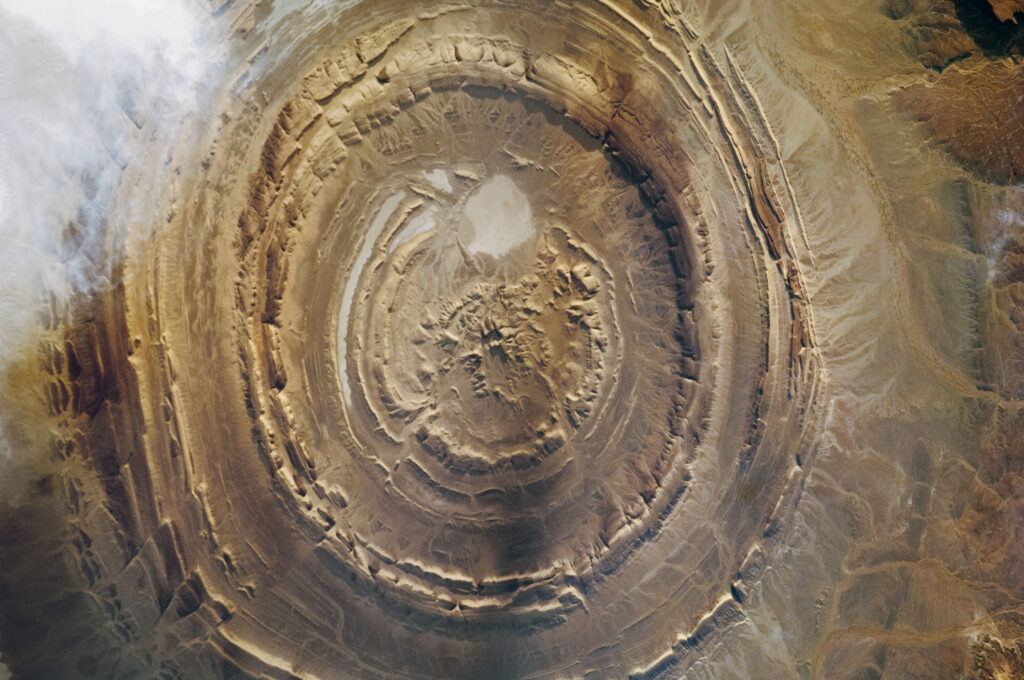
Had some discussion about potentially adding Atlantis to the stories in the future. Maybe using the Sahara Eye. Major question to be resolved is how to destroy Atlantis so it is at least similar to the Plato story. One minor question would be how much metal reinforcement do they need? If they build in a Classic Greco-Roman or Gothic style, none. If they use steel like we do – the steel would probably be rusted to nothing and those structures compromised. If they use a more corrosive resistant metal (titanium, aluminum, special alloy) they may still be in place. Something to consider.
Something else that will show up earlier is how will the Selenites gain support among the communities under the control of Zafir? What if the Selenites are able to disguise themselves sufficiently to carry word of the coming freedom to everyone. Among other things, Angels are messengers. What if the people under Zafir’s control end up entertaining ‘angels’ unaware?
If Old One tainted leukos crystals are purple-black (like a UV light), and Moon leukos crystals are usually colorless or pale yellow, would Martian power crystals be red? After all, the reason Mars looks red in real life is the massive amount of iron oxide in the surface dust. Come to find out, Corundum (aluminum oxide crystals) with trace amounts of iron and tungsten make blue sapphires. Rubies come mostly from chromium traces. Of course that doesn’t mean I have to make Martian crystals blue…
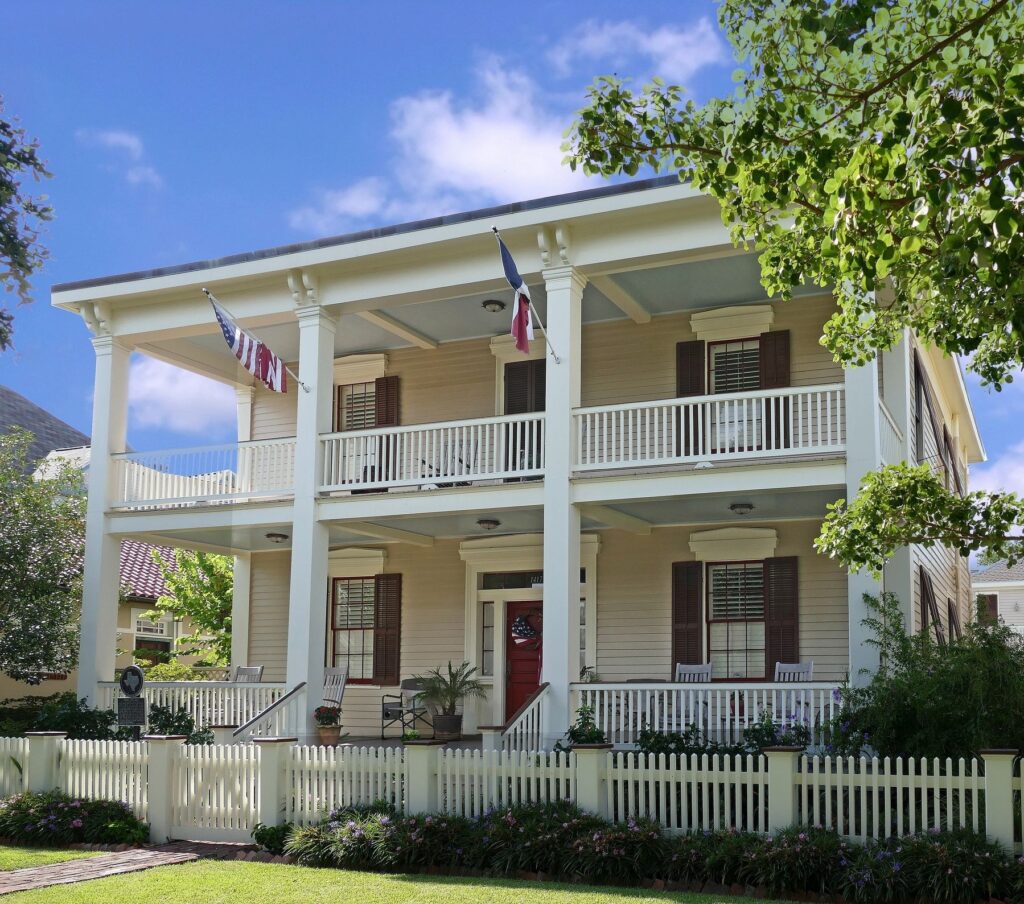
I discovered that in real life, while Gresham Castle was being constructed the Gresham’s lived just behind the house on the south side of Avenue I between 14th and 15th. It is listed as the Thomas Chubb house on the historical landmark plaque out front of it. That is Edward and Vickie’s house in the story.
I also looked up what the major ports were at the end of the 19th Century. They were the ports of the “Northern Range” in Europe. That’s Le Harve, France; Antwerp, Belgium; Rotterdam, Netherlands; Bremen/Bremerhaven, Germany; and Hamburg, Germany.
Chapters this week: 21: American Commonwealth Military Council – added before 22 22: At This Meeting of the Board… – completed 23: Grey Wednesday 24: Galveston Aeroport Collusion
Forging The Chain Breakers word count is 45,808, not counting Dramatis Personae (1,831 words)
Artemis Rising is #1,162 in Steampunk Fiction, #3,967 in Alternate History Science Fiction (Books), and #6,602 in Exploration Science Fiction. There are still just 2 customer reviews – if you’ve finished the book and haven’t left a review, please do so.
I realized some additions to Mirim for the WIN need to be made to clarify the size of the challenge, as seen from Mirim and Elisha’s point of view. Elisha is, essentially, the headman of a village tasked with representing all the people of the Moon (less than 100 thousand) to an organization that has multiple countries with millions or tens of millions of people. Mirim, for all her skill, has never attempted working a Women’s Information Network the size of Galveston’s. Mirim has also never worked with women who are wives of diplomats, or even Presidents, of those huge countries. All that is on top of being on a completely alien planet. I guess I didn’t write it because I knew how they would cope, but the reader would have to be able to read my mind to know how they cope. Sandra said she had recognized that, but to wait until she’s made a first pass before I start a significant rewrite like that.
I did go through Mirim for the WIN and Antarctic Honeymoon to look for places to put descriptions of the various locations in Galveston to make the story come alive better. That took up most of my writing time this week.
Biggest news last – Mirim for the WIN is a great slice of life, but a very poor story. Everything is too easy and there are no real challenges or setbacks. It also doesn’t really fit into the Steampunk genre because there isn’t really any adventure. It looks like I’m going to need to back up, rethink what I’m doing in the various books in 1891, and try again. I’m not sure yet, but that will probably mean Mirim for the WIN will not be the title of the next book. Work on Antarctic Honeymoon will be suspended until I get Book 2 straightened out.
Artemis Rising is #860 in Steampunk Fiction, #2,344 in Alternate History Science Fiction (Books), and #799 in Steampunk Science Fiction (Kindle Store). There are 2 customer reviews – if you’ve finished the book and haven’t left a review, please do so.
In the late Victorian and Gilded ages, the rich and powerful were more likely to have a custom rail carriage built for them. Kind of like having a yacht or private jet today.
Ran into some major issues with the first chapter of Mirim for the WIN. Essentially I needed to do a complete rewrite. Since I’ve never written the first chapter of a sequel novel, I guess it isn’t surprising that I’m not good at it yet. I ended up adding more than 3000 words making the first chapter over 5,000 – way longer than most of my chapters. I asked Sandra to suggest chapter breaks, but may leave it alone if she doesn’t have suggestions. It made me feel good that I impressed her by getting the rewrite back to her in less than 48 hours.
Saturday visit to Galveston helped me locate a hugely valuable source of information in the Galveston and Texas History Center of the Rosenberg Library. Huge shoutout to Kaitlin and Christina for their help gathering information about Walter and Josephine Gresham, Gresham Castle, John Henry Hutchings and his house.
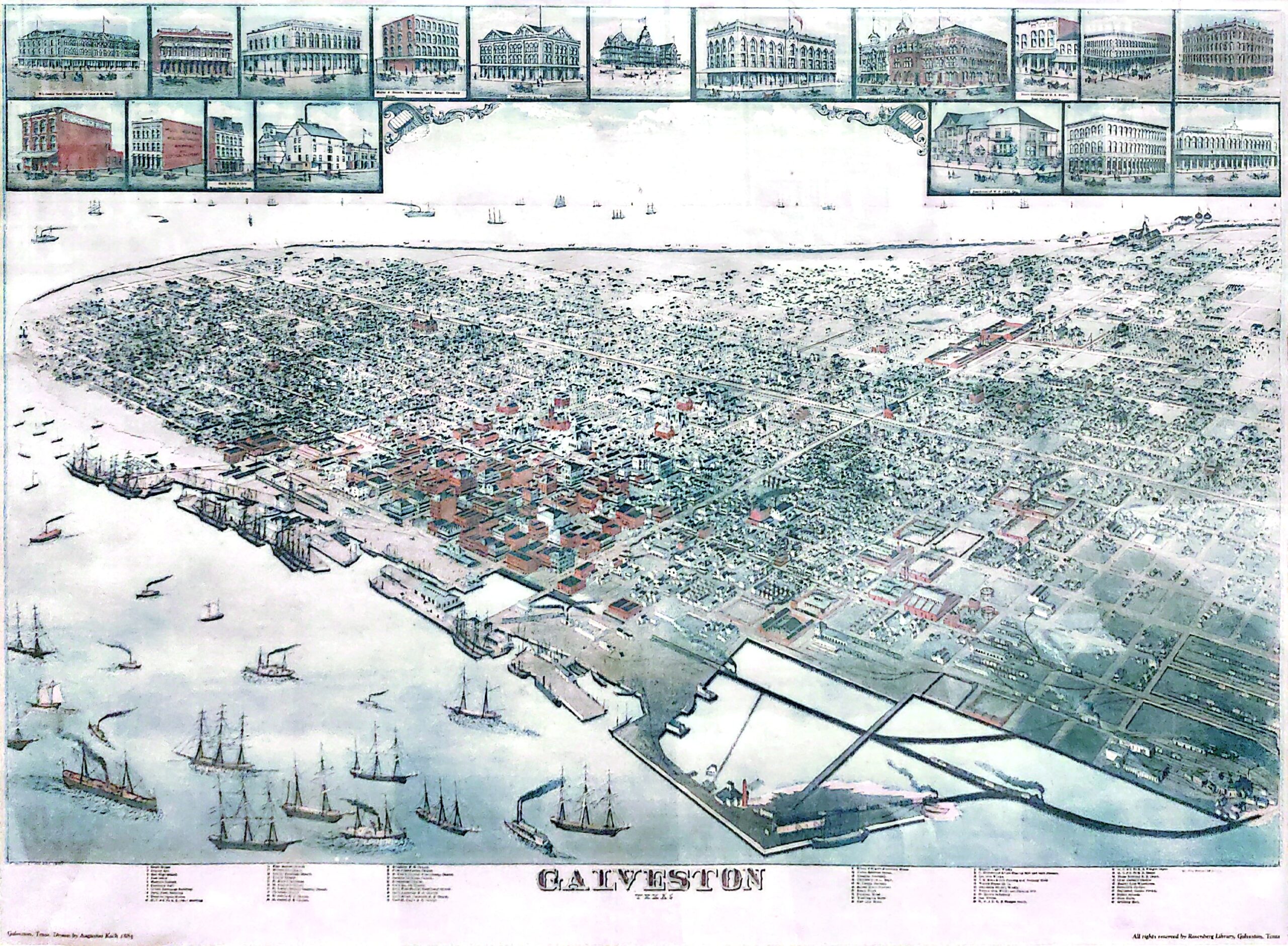
There was also a birds-eye view map of Galveston on the wall that included the Beach Hotel (so between 1882 and 1898). The beach side of the island and the west side of the island was way too empty to justify going back and forth to Texas City. The way I see it, I have three choices: 1) I can revise everything I’ve written so far to put Gresham Aerospace on the island from the beginning. Pro: It takes care of all the issues from the beginning. Con: It makes it confusing for people who have already started reading Artemis Rising and it is a lot of work. 2) I can have the Gulf, Laredo, and Veracruz Railroad at least decline developing the Aero/Aether port in Texas City and force the move when Gresham Aerospace makes their expansion in Antarctic Honeymoon. Pro: Allows Artemis Rising,Mirim for the WIN, and almost all of what is written so far for Antarctic Honeymoon to stand as written. It also puts Galveston right next to the Aetherport which will be important later. Con: the facility is on the unraised island during the 1900 hurricane. It also adds some complication to the Antarctic Honeymoon story (which may be more of a mixed Pro/Con – richer story/more work). 3) Move the facilities from a ruined Texas City location to Galveston. Pro: This can include a raising of the level of the ground post hurricane and it makes some sense in trying to revitalize Galveston after the destruction of the Hurricane and such. Con: I’m pretty sure the Texas City area has a lot less destruction from the 1900 hurricane than Galveston did – moving from Texas City to Galveston would stretch credibility a lot.
Toured Bishop’s Castle and Moody Mansion. Bishop’s Castle is the name given to the Gresham’s house, Gresham Castle in the books, after the Bishop of Galveston took up residence there. Moody Mansion was the name given to the mansion built by Narcissa Willis when William Moody, Jr. bought it just after the 1900 hurricane. Narcissa had the mansion built in part because she had pestered her husband to build them an opulent house their entire married life, in part to try to draw her children back to Galveston, and in part to upstage her sister, Magnolia Willis Sealy, mistress of Open Gates just two blocks down Broadway. She upstaged her sister for a very few years, got her opulent house at the cost of not having the money to keep it up, and since that estranged her from her children, failed to get them to return to Galveston. In fact, William Moody got the mansion for about five cents on the dollar in a bid he put in before the hurricane.
Learned that Broadway is where it is because that was the “ridge” of highest ground (8 feet above sea level) down the center of Galveston Island when the city grid was laid out. At the time of the books, it consisted of a single lane road in either direction and a broad esplanade down the center. Most roads in Galveston at that time are paved in crushed shells.
I did figure out how to make some decent AI generated pictures of the various Embassies. I’m not sure it will work for the Hall of the American Commonwealth, I’ll have to try that next.
This week was mostly consumed with research in Galveston. Learned a lot and need to integrate it into Mirim for the WIN, as well as later books. That will probably slow down progress on Antarctic Honeymoon for a while.
Chapters this week: 27: American Geographic Society – progress Mirim Chapter 1 rewrite
Antarctic Honeymoon word count is 53,807, less than 800 words more than last week, not counting Dramatis Personae (2,268 words)
If you want to be a beta reader and comment on these chapters, write a nice review for Artemis Rising on Amazon or Goodreads, and email me that you’ve done it.