This is just too big a learning to be part of the standard weekly blog – so it will get one all its own.
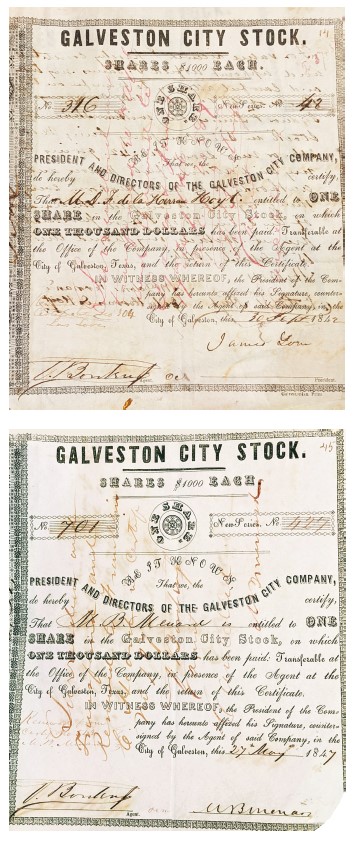
During the time of the Selene Reborn books, the Galveston City Company still had a huge amount of influence on the development of Galveston because they owned virtually all of the undeveloped land in the city.
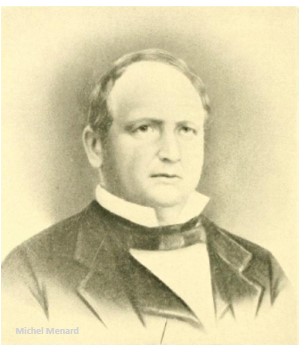
It all starts with Michel Menard, one of the signers of the Texas Declaration of Independence and, among other things, a location surveyor. The surveys most people are familiar with are boundary surveys – what are the boundaries of a tract of land. A location surveyor would go to a tract of land and identify improvements and geographical features that could add value to the land. He performed this service for Juan Seguin on a tract of about 4,605 acres on the east end of Galveston Island. The exact details are unknown, but Seguin gave title to the land to Menard in 1834.
In 1836 Menard petitioned the government of Texas to have the Mexican land grant confirmed. Since the early Texas Congress was notorious for being… chaotic, it isn’t surprising that it wasn’t until 1838, after the Texas Congress had time (and some coups) to get itself organized before they officially deeded Galveston Island to the Galveston City Company consisting of Menard and 9 other early luminaries of Texas and Galveston.
For the next 71 years, the Galveston City Company would sell and/or donate land to guide the growth and expansion of the city of Galveston. In 1891 when Gresham Aerospace is trying to get large tracts of land for their half-mile long aethership factory and such, In addition to getting permission from the City Council to build over where streets are supposed to go, they would need to buy all, or most, of the land from Galveston City Company, Archibald Campbell, agent and secretary.
This is not the way I’ve ever heard of anything going. I guess it is kind of like master-planned communities now days, but without a detailed master plan to start with and with decades of incremental development instead. I think it is interesting that a Communist could make a case that the Galveston City Company is an example of central planning done right since they controlled, or at least influenced, the development of Galveston into a well-organized, prosperous, philanthropic community. Of course a Capitalist would point out that it was a private, for-profit enterprise, not a government agency, that did it…